
-

How to Enjoy the Holidays on Your Terms at Work
In case you haven’t noticed, the holiday season is in full swing! Halloween wasn’t even fully over before turkeys and stockings rushed into spaces that moments ago housed skulls and cauldrons. And as we near the “traditional” holidays, we understand that not everyone has the same religious observances, if any at all. This can make the upcoming months tricky as companies are apt to throw holiday parties that are inclusive of some folks, but not all.
-

Adjusting to Hybrid Work Life
Hybrid work life has arrived, and with it, a slew of challenges. There’s much to navigate, from childcare to issues transitioning back into in-person conversations with colleagues, managers, and clients. And let’s not forget the biases and microaggressions that can rear their ugly heads when back IRL. Here are some tips for navigating the hybrid work life. When you’re remote: When you’re in the office: Work, as we have historically known it, has forever changed, and that isn’t necessarily a bad thing.
-

Five Steps You Need to Take Before Creating an Employee Resource Group
Employee Resource Groups, also known as Affinity Groups, are voluntary employee-led groups that can promote inclusion and diversity within an organization. They’re often comprised of employees with common backgrounds, interests, and identities. ERGs can contribute to an employee’s sense of belonging and are also considered an important way for organizations to support their diversity and inclusion goals. ERGs can be a great way to build community and support among employees who share a common identity or experience, but they require careful planning and execution in order to be successful.
-

The Dangers of Perfectionism in the Workplace
“I don’t feel like I’m perfect enough, and therefore I’m not enough.” Have you ever felt this way before? How often do you internalize your performance and what you produce to measure your inherent worth or value? Growing up, I remember hearing family members, teachers, and other adults telling me that perfectionism was something to strive for, and I did (or at least tried). As you can probably guess, I couldn’t achieve such an unrealistic goal.
-

International Pronoun Day
Today is International Pronoun Day, which takes place every year on the third Wednesday of October. International Pronoun Day recognizes the importance of addressing someone by their correct pronouns. Activists, LGBTQA+ educators, and resource centers share why pronouns are essential and further the conversation around making pronoun-sharing commonplace. Why do pronouns matter? Referring to people by their correct pronouns indicates your respect for someone’s identity. When we assume someone’s gender and/or pronouns without asking first, it can send a harmful message.
-

Why Leaders Should Care About World Mental Health Day
Today we join the rest of the world in observing World Mental Health Day, a practice started by the World Federation for Mental Health (WFMH) in 1992. The WFMH has worked since 1948 “to advance, among all peoples and nations, the prevention of mental and emotional disorders, the proper treatment and care of those with such disorders, and the promotion of mental health.” Since 1996, the WFMH has developed an annual theme that embodies the global conversation around mental health. This year’s theme, “Make Mental Health & Well-being for All a Global Priority,” is especially fitting.
-

How to Support Employees using a Trauma-Informed Lens
The world is going through multiple collective traumas: the onset and continuation of the Covid-19 pandemic, racial and political unrest internationally, natural disasters, and impending threats of a financial recession. And while all of this is happening, employees are expected to go to work and be productive, despite our varying responses to traumatic events. When they’re over, we’re expected to act as if nothing ever happened at all, returning to “business as usual” for the sake of our employer’s bottom line and our individual need for a paycheck to survive. Our brains, however, don’t negate the experience as quickly, if…
-

Reflections from Leading DEI Conversations
We asked co-facilitators Kia Rivera and Victoria Verlezza to reflect on what they learned facilitating the Leading DEI Conversations Program. We’re excited to see what we’ll learn from our new cohort! If you’re interested in joining us, learn more about Leading DEI Conversations and sign up.
-

We’re Relaunching our Community! Rise together with us
A little history In 2013, we hosted our very first event as Boston Girl Geek Dinners. Our events were designed to support and connect women+ in tech and tech-adjacent roles. Now, almost ten years later, we’re relaunching our community to be more inclusive, with the same high-quality, safe, and fun-loving atmosphere many of you know us for! In 2017, we expanded beyond events and community, and started facilitating workshops on creating more diverse, inclusive, and equitable workplaces. We deliberately chose to focus on the workplace as the way to frame the context for our trainings.
-
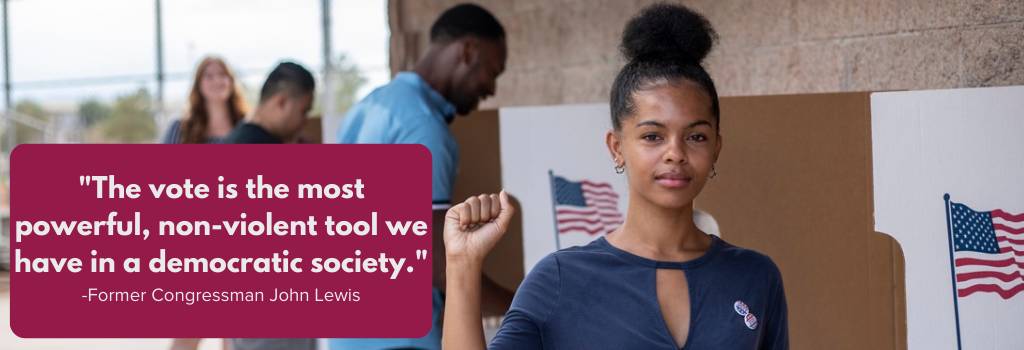
Why We’re Still Civically Engaged: the vote like your life depends on it because it does edition
This is the fourth election year that Inclusion Geeks is involved in getting out the vote. Let’s quickly recap: As an organization, we’re engaging once again in this election cycle, and we want to make it very clear how we view the connection between our work and elections. Our mission is to abolish inequity in the workplace. We chose to focus on this particular space because, for many of us, work is where we spend most of our waking hours, and in many ways, it’s a microcosm of the world around us.
-

Reflections on Hispanic Heritage Month, Machismo, and Intersectionality
Is It Me, or Is It Machismo? Hola, amigues! Happy start of Hispanic Heritage Month! Hispanic Heritage month has been recognized since 1986 and runs from September 15 through October 15. Did you know that it is the one cultural observance month that is split between two months, instead of just one? From September to October, Costa Rica, El Salvador, Guatemala, Honduras, Nicaragua, Mexico, and Chile all celebrate their independence days (read: the end of the Spanish colonization in those countries).
-

Why “Resting Bitch Face” is Sexist
I have a very…stoic face. When I’m going about my business, my face in its natural state can be “pretty off-putting” (or so I’ve been told). I’ve even been reprimanded professionally for appearing to be disinterested in meetings and not being welcoming to esteemed guests (read: I didn’t have a smile plastered on my face the whole time). Men constantly make comments at the gas station, the gym, the grocery store, or any place where I’m just minding my own business for me to smile.