



About The Episode
Transcript


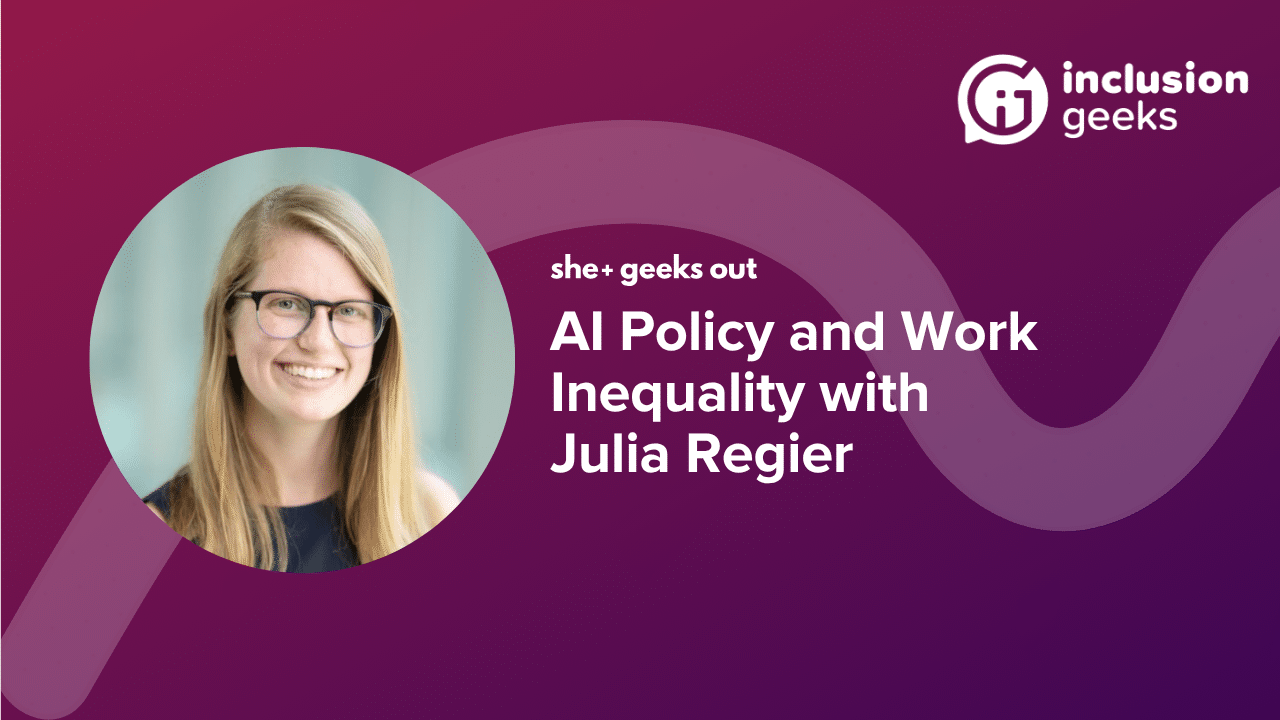
Julia Regier is a policy and research manager at MIT's Stone Center on Inequality and Shaping the Future of Work, where she focuses on workforce and policy impacts. Her path here was anything but straight, from studying philosophy at Wellesley to an MBA at Yale to translating dense economics research for people who don't speak economics.
We talk about what the data shows for workers without college degrees (spoiler: it's not great, and it’s been getting worse since 1980), why the self-checkout AI surveillance story is a perfect case study in automation gone wrong, and what it would take to redirect AI development toward something that works for workers, not just around them.
We also get into the market failure at the heart of how AI is being built, why a handful of people setting the vision for all of us is a problem, and what policy levers could shift things. Julia also makes the moral case, loud and clear, for a living wage, and we’re here for it.
Chapters
00:00 - Intro - Felicia and Rachel talk local politics, civic assemblies, and more
20:28 - Welcome Julia! Her Nonlinear Path: Philosophy, Recruiting & Landing at MIT
25:00 - Worker Ownership, Co-ops & Why It's Harder Than It Sounds
29:35 - Job Quality for Workers Without College Degrees: What the Data Shows
37:00 - AI Surveillance, Self-Checkout & the Annoyance Factor
43:45 - Taking the Long View: Policy Impacts & the Case for Investing in Children
49:40 - Who's Setting the Vision for AI (and Why That's a Problem)
54:26 - Pro-Worker AI: Policy Levers That Could Actually Change Course
62:00 - Gender, Diversity & Who's Missing from the Research
65:20 - If You Could Change One Thing + Closing Thoughts
[00:00.1] Hi and welcome to the she Geeks out podcast where we geek out about workplace inclusion and talk with brilliant humans doing great work making the world a better and brighter place. I'm Rachel. And I'm Phylicia. Our guest today is Julia Regier, policy and research manager for workforce and policy impacts at MIT's Stone center on Inequality and Shaping the Future of Work.
[00:27.8] We talk about her nonlinear path from studying philosophy at Wellesley to a Yale MBA to her current research at mit, what the data shares about job quality for workers without college degrees and what it would take to push AI development in a more pro worker direction.
[00:43.0] Wild. Yes. But before we get into that awesome conversation, it is really interesting. So stick around. Let's get into it. As always.
[00:54.6] Lovely. Dear listeners, it is Thursday, May 21, and in the morning, my time here in California and almost the afternoon for Felicia. Yeah. In western Massachusetts. Because we are not in the same place.
[01:10.1] We are not. And I'm not gonna lie, I am very tired. This week has thoroughly exhausted me. Same. Is Mercury in retrograde or has Mercury just taken itself out of the equation completely? Or as my friend likes to say, is Mercury in Gatorade?
[01:27.1] Gatorade. It's definitely Gatorade. Like, does Mercury even happening right now? I don't know. I don't know. There were lovely listeners. There were a lot of different ways that we were thinking of taking this conversation and we've decided to go local.
[01:44.3] Yeah. Yeah. I feel like if anyone wants to know other ways, you should hit us up for a non existent patreon and we'll tell you what the good goss is. But local is good goss too. Do you want to kick off Rachel or do. Or shall I? Yeah, I can kick off.
[02:02.1] So I am in San Diego and as I mentioned in the think the last episode, I am now on the board of our local neighborhood planning committee. Which is very exciting. I actually have a training coming up on Rob Rules. Robert.
[02:17.4] I call him Rob. Rob's Rules. Rob's Rules. We go back, we're super cash. Robert's Rules and the Brown act and sort of all these other things that you need to know about how sort of local government stuff works. So I'm excited for that.
[02:33.0] And I had my first meeting where I was the secretary and it did require some work. I people were very impressed with my typing skills. I am very quick. And I was able to retain pretty much every board member's name considering it was only in my second meeting, people were very impressed, so I'm glad I made a positive impression.
[02:54.3] But we talked a lot about the budget, here in San Diego, which is incredibly problematic for many reasons. And if you're following any of the national news, you've seen that San Diego has also made the news because of the horrific murders that happened at the largest Islamic center here in San Diego early, earlier this week.
[03:15.9] And the you know, just continued disappointing response from our fearless leader, which, if you're on the Internet, you, I'm sure will see some of the clips, from him. I will say I have not been a fan of his for quite some time.
[03:33.7] And so it is good that he's being sort of called to account on a variety of issues, this being one of them. All that said, I'm very happy to be involved in local, in the local space. Space here because, it's sort of like the nervous, system's equivalent of touching grass kind of in a way.
[03:58.8] Sometimes good, sometimes bad, I guess. But yeah, yeah, it feels more real, you know, than I think when we look at all the news that's happening around the world that we have absolutely no impact over. And it's. So it's kind of nice to be able to, to at least focus on things that feel a little bit more immediate that we can have some say on.
[04:18.5] Yeah. Well, speaking of AI, do you all record your meetings and do you have AI note takers? That's a really good question. So we do record them. They're on zoom. So it's sort of just, for public accessibility reasons. And then we do record them, make them available also for accessibility reasons, as a note taker.
[04:41.1] This is my first time we haven't transitioned to like using actual notes, Zoom notes. So I'm still in there doing it, but I could see that happening. You know, it's funny that you say that and as we talk about AI and you know how I feel about it, I think it's just an incredible tool.
[04:57.2] But as I was doing some work today, I was just thinking how it's still kind of important to have a human involved. I was thinking about this very case of having to take notes and having AI just generate everything. If we do that, then like, I'm just personally not going to retain the information that occurred in the meeting.
[05:16.8] And then on top of that, like, if, if it is wrong, which AI is not perfect just the way humans are perfect, it's just Nice to be able to sort of question, what's happening. And so I think as much as there is a lot of fear around humans not being able to, that there won't be human involvement in whatever our future is it just as pro AI and pro tech and tools I am, I still cannot envision a world, and maybe this is my limited imagination, where the human experience won't be, incredibly valuable to the world.
[05:57.9] If, with the caveat, if we can get out of our own way and stop being such terrible humans. I, I asked because we, over in my side of the country, tiny East Hampton, the city uses Google, so they're Google Shop, and they have Gemini.
[06:19.8] So Gemini is automatically set up to automatically take, notes and do transcripts for all the recordings. And same as you in San Diego, we record for accessibility purposes and records purposes. So what I have found interesting is because I'm a clerk for a couple of our subcommittees, and so I'll get the notes sent to me automatically.
[06:38.9] And it can be really, really helpful because sometimes, you know, sometimes stuff does get complicated depending, on you're talking about. So it can be helpful, but it's actually almost, you know, always. I usually just still use primarily my notes because it doesn't, for example, it doesn't have the capacity to tell who's talking.
[06:58.7] So it can sort of misrepresent who said something, or it doesn't know who's in the room. So it's just this sort of like this big block of text and it doesn't capture everything accurately. So it's just one of those things where, it can be really helpful, but it also isn't like, oh, we've solved this and now we don't need to have a human do this stuff.
[07:17.0] That's so true. Because even when you have to say, like, you know, you're counting, you know, who's saying I, who's saying nay, who's motioning, who's the second to motion? It's not. At least not now. It's not good enough to be able to parse all that stuff out and difference between public comment versus what's happening.
[07:32.4] So, yeah, that's cool that you use it, though, in the future. Not something I chose personally, but it was here when I joined as a city councilor. So, yes, we, we do use it. We have a very rudimentary draft AI policy that IT departments working on.
[07:50.4] But, yeah, I mean, it's definitely like you said, I think, you know, AI is here. People are using it. There's obviously considerations around it. We can't just give over everything. I think humans, personally, I think humans are still essential. And I can't remember where I read this, but I read recently someone was talking about like AI and art and creativity.
[08:09.7] And I'll paraphrase because I'm not remembering the exact statement, off the top of my head, but essentially the, the quote or the statement was something like AI can only look backwards and creativity. And that has so stuck with me. And I think that's kind of like the energy I'm taking with me, what I'm thinking about AI going forward.
[08:29.3] Because it's true, I think, you know, AI is using data and looking at patterns, but it's looking backwards to create. But humans are the ones who are the visionaries who are able to look forward and create something out of nothing. For now, that is absolutely true. That is the big differentiator is like, that is about what is AI, Consciousness versus human consciousness.
[08:49.0] Yeah. Lord knows we've been talking a lot about and thinking a lot about consciousness. I know we have and I'm sure a lot of our listeners are as well because it's, you know, it is top of top of mind. And it is interesting when we think about.
[09:04.7] Because AI, it's so fun. I'm curious what your thoughts are on the, the backlash of the wealthy white celebrities that are like, hey ladies, you've got to use AI or like you're going to be left behind. I'm just curious what you think of that.
[09:22.4] Yeah, I mean, I think, I'm not surprised. I guess is, is my response to that. Not super surprised. I think we've seen other things come through like, you know, I'm thinking about like NFTs, Bitcoin to a certain degree lean in where it's, you know, it was super popular and then people were like, wait a second.
[09:41.7] So I do think that this is kind of like kind of par for the course in the sense that people, I, I think there's a lot more to it than just like an AI specific backlash, but I think that's a big piece of it. But I also think that people in general, my sense is that folks are getting tired of celebrities and this really out of touch like wealth inequality and people who are rich and in a lot of cases white and privileged and out of touch telling the masses what to do when they have no clue what is happening or like what real life kind of is for very many folks out there.
[10:20.3] So I think That's a, huge piece of it as well, where it's like, hey, you should be using this. And people are like, I just got laid off because my job got taken by AI, so don't tell me what to do, you know, But I will. But I do want to use your skin care regimen. That is something I would like. Oh, the skincare regimen is a lot of plastic surgery, I would say.
[10:36.9] Yes, please know for, for listeners. That was my, that was my sarcasm, coming through. What is it? Forward slash S, As the Redditors would say. All right. But yeah, I mean, I think, I don't know, I was just talking about this with this morning with someone where I haven't really dug too deeply from a mental perspective into this line of thinking.
[10:59.1] But I do think there is going to be some sort of an AI bubble coming and I just don't know what it's going to look like. I don't know if it's going to be really severe, like with NFTs, where I just think about how all these rich people were buying these monkey pictures and it was supposed to be the next coming of money.
[11:18.6] And then that fell apart and was stupid. So I don't know if it's gonna be on that scale or if it's gonna be more of like the Internet bubble where, you know, obviously the Internet is still here, it controls our lives. But there was definitely a bubble around that, as you know, I know firsthand. So I'm not sure, but I think there's gonna be some kind of a bubble.
[11:35.7] So I think to your question, like, I think this backlash is a, is a symptom or a signal that, you know, we're not. People don't want to just go full force ahead with AI. I think people questioning it, you know, we're questioning it. Right. Like we just. Our webinar that we did yesterday, on how to ethically hire using AI or can you even do that?
[11:57.3] And I don't think there's a clear cut answer at this point. Yeah, so I agree. And I want to share one other thing before we get to our lovely guest that you made me think of is I read this lovely article which I'll share in, the show notes in the Guardian that came out this morning around civic assemblies and how more people are getting involved in, basically helping to shape local policy in large cities and small ones.
[12:25.2] So, the case study that they used was talking about la. They talked about Fort Collins, Colorado, but they Also talked about, this particular civic assembly in Snohomish county, Washington, where 40 residents were talking about how local government should use AI, AI tools and then presenting that.
[12:44.4] And apparently what's been happening is they're presenting these to the city councils and they're adopting most of the initiatives that are being put forth. So it's not just like, oh, they're just sort of sitting around and like pie in the sky, whatever. And then like the council's just ignoring it.
[13:00.6] So I think it's really smart, especially when we're thinking about AI because, you know, in my little, very limited time, I know you've been doing it for, for much longer, like, and in this very, very small, tiny little way, I see how, how deliberation makes things just take so long.
[13:22.6] And it is understandable. Like it is. It actually, it. I get why it has, it happens that way and it does explain why it feels like it's impossible for like politics. Yeah. For things to get done.
[13:37.9] Especially thinking about AI and like, how do you get ahead of anything when we're just trying to like, keep up, you know, it's really interesting. Yeah, it's, it's so real. And it's funny you say that too because I was just thinking about this because I had our, you know, we have two meetings a month for city council.
[13:54.7] So I had our second meeting for May last night and it was a long one. I think it actually was the longest I've had since I'd been on council in Seoul for the last year and a half. So it was four and a half hours. We start at 6pm, got home at 10:30, 10:40. As I was telling you earlier, I had my dinner at 11.
[14:11.6] Don't recommend. Brutal. Normally, I do try to bring a snack with me because sometimes so. And also just so folks know, like when we have these four hour meetings, we have typically one five minute break. So it's not like we're taking like, you know, even a 10 minute break halfway through.
[14:29.5] When I do trainings that are two hours, I give people a 10 minute break. So it is rough, I'm not gonna lie. Like, it's actually physically hard on you. Yeah. For that long. And to sometimes, like, sometimes the air conditioning goes off or the heat kicks in or off as the case might be, depending on the season.
[14:46.9] So then you're sitting there and you're like sweating or you know, whatever it might be. And it's just to your point though, like the meetings get these long because you have to go through the things. And that's what I think a lot of people don't understand about like local government is that, you know, we're not all sitting around debating stuff because we enjoy dragging things out.
[15:08.8] Although maybe there are some people who are like that. But for the most part it's like, because we're, we're doing it to raise our own valid questions. We're doing it to try to hold people accountable. We're doing it to make sure that we're not putting in place like a law or a policy or an ordinance that's going to have negative impacts on people, that we've considered all the sides of an argument, trying to bring forward our constituents voices.
[15:32.9] And so, you know, to your point about those 40 people who are interested in the AI stuff like, you know, we have, I have people reaching out to me all the time with things that they want to see happen or their agendas or their issues or concerns. And that's part of my job, is to bring forward what my constituents are coming to me with.
[15:50.9] You know, and then there. All the other big piece of it too is that in most public bodies, when they come together, we have public speak. And that is also, you know, there is a lot that comes through there. And you can't just tell people, hey, we are not going to have public speak today.
[16:08.0] That doesn't give people a voice. And you know, it depends on the city and the structure. But like for us, typically, you know, we do limit the amount of time an individual person can speak. So typically it's about three minutes per person. But we don't limit how long public speak takes in and of itself.
[16:27.5] So you know, we had yesterday we had a recognition. So just as a side note, before we get into Julia's conversation, we had this thing called we the People here in East Hampton. It was something that I was familiar with growing up, but it's basically like a high, school team that studies the Constitution.
[16:46.3] And then they sort of like, it's almost like debate, I guess. I'm describing it really poorly, but you're doing great. But it's a thing where they do like competitions at the state level and then there's also national level competitions. And so our tiny little East Hampton high school team is amazing.
[17:02.4] And they have for the past nine years, nine years in a row, they've won Massachusetts at the state level. So they're we the People champions at the state level. To put in perspective, East Hampton is a city of 60, 16,000 people. So Massachusetts has, you know, 300 plus towns and cities.
[17:18.4] So the fact that they're winning over like Boston or other places that have a lot more resources is really a testament to the teachers who run the program and the kids themselves. But we did a recognition for the we the people. And then we had public hearings for a number of different things. And public hearings have to start on time because they're advertised.
[17:35.8] So if you have public speak, you have to pause it to go to public hearing, then you come back to public speak. It gets confusing for people, especially if you've never been to a meeting before. But we couldn't do any public comment because we had to go right into public hearings. So that took us from 6pm, 6:15, really, when public hearing starts to, I think almost, 9:00pm So 9:00pm that's when public comment started because that's how long public hearings took us.
[18:02.7] You know, people, we had someone come up to us and say, hey, you know, people have been waiting around and we're like, we get that. We respect that. We feel for you. This is the way it has to be. Because this is the process, right? And the public hearings take as long as they need to take. And they have, their own public speaking part of it.
[18:19.1] So then we started public comment. And then that took a while because there was a lot of people who wanted to talk about stuff because we're, we're dealing with a major budget crisis right now. There's a lot of stuff happening. Teachers getting laid off. I mean, staff is getting laid off. So people are upset, they want to share. That's all absolutely, you know, valuable and important and real.
[18:35.6] But then we still have to do our business after that. So as you can see, it's a, it's a long night, but it is what it is. And you know, part of you wants to just like, be like, wrap it up, we're voting yes. Who cares? Let's keep this going. But then you're like, no, we have to get into it because that's the whole point of us doing this.
[18:52.2] So it really is, it's tough. I had one Jolly Rancher at like 8:30pm that got me through for the night. Brutal. Brutal. Yeah. We had this whole discussion around, like putting in this letter for, to talk about the budget, just to submit to our council person.
[19:08.5] And, the original, the draft had a statement about ways to, get money from the city. And one was through parking, fees for the municipal airport to get sort of, you know, private Planes to sort of pay up.
[19:25.2] And there was actually a lot of sort of back and forth around cutting that line, because there was, like, you know, potential, pilots use it. Like, it's not just, like, wealthy people. And so it was, like, a lot of back and forth conversation, and it was the only one that sort of was, like, contentious.
[19:40.8] Normally it's like, you know, almost everyone says yay to it. And so when it's, like, kind of split, it's like, ooh, and then. But we're like, spending, you know, 20 minutes on this topic that is like, will it even make a difference? I don't know. But, like. But you have to have the conversation.
[19:56.4] Right? And that's the other funny thing, too, is, like, I always feel like no matter how much I prep for these meetings, every meeting, there's, like, something that comes up where I did not anticipate that that was going to be the thing that we get stuck on. Totally. Like, but it happens, so it happens.
[20:12.7] Anyway, I know we. We chatted a lot. We could have a whole podcast just about local politics. Maybe that'll be the next one. Sure. Maybe. Let's go. All right, well, let's get into our conversation with Julia, because that was also a really great conversation. So thanks for listening, to us. But now let's bring Julia into the mix.
[20:28.7] Yes. Yay. Yes. Welcome to the show, Julia. Welcome. Our lovely guest today is Julia Regiere, policy and Research manager, Workforce and Policy Impact at mit. We are so excited to have you here, Julia. Yeah. Yeah. Thank you for having me.
[20:44.0] Good to be here. Yay. So let's get this party started. Your path is wonderfully nonlinear. You studied philosophy at Wellesley, you got your MBA at Yale, and now you're at mit. Can you talk a bit about your path and what led you to the work that you do now at mit?
[21:01.5] Yeah, absolutely. And, thanks for saying that. You know, I'm a huge proponent of the liberal arts. I love studying philosophy in undergrad. You know, I think philosophy majors sometimes get a lot of heat. But then also, you know, now, especially in the age of AI, suddenly people who've, you know, thought about ethics and, like, what does it mean to be conscious?
[21:21.2] Are suddenly seeming more useful. But, you know, I think even more than that, I think studying philosophy really just taught me a lot about how to organize my thoughts and kind of structure an argument and how to write. And so I think sometimes there's this perception that it's kind of just sitting around in a room pondering the Meaning of life, but really it's a lot more about logic and structuring an argument.
[21:42.3] So yeah, really enjoyed that experience. But I didn't feel like I wanted to continue with a PhD in Philosophy. I kind of just wanted to get out of the bubble of academia and try something new, work with people. So right out of college I started my career in recruiting actually.
[22:00.5] And I, I was specifically recruiting for environmental health and safety jobs, across the US in particular working with a lot of manufacturing companies. And so that really exposed me, I think to a lot of just dynamics in the labor market that I hadn't been aware of previously.
[22:19.4] And including how that field was becoming more professionalized. And I was kind of seeing how people who maybe had a lot of years of experience but didn't have a degree or certifications were being left behind to some extent. So I had all of that kind of in the back of my mind when I went to get my mba.
[22:38.0] And I was always wanting to pivot to something that I felt like would have positive social impact. I had a particular interest in economic mobility and workforce development in the US And partly I chose an MBA because I did have that liberal arts background.
[22:54.1] And so I was wanting to just build up my skills and things like that like finance and accounting. But you know, the Yale School of Management's also a pretty unique place as business schools go. And so you know, I did find a lot of opportunities to work with nonprofits while I was there and just focus on the issues that I was passionate about.
[23:12.5] You know, I did some work in the worker ownership space for my summer internship which was super fun. And then after graduating I came to mit. So I'm now a policy and research manager working with two centers doing economics research, with relevance for policy.
[23:31.4] So one's focused on inequality and shaping the future of work and kind of how technology is shaping work. And the other is really focused on standardizing policy evaluation. And so I do a lot of different things, but a good chunk of my work involves trying to translate our findings for abroad and non technical audience, which I really enjoy doing.
[23:53.8] And it's kind of funny, I'm actually drawing more on the economics classes I took in business school, maybe more than I would have expected to. And I actually used to think that I actively disliked economics. Hopefully the faculty I work with won't hate me too much for saying that, but I think I had some outdated and somewhat simplistic conceptions of what it Was.
[24:15.6] And I think a lot of people actually do who aren't in the space. But I actually was exposed to some of the research from some of the faculty I work with now, while I was in business school. And I was like, this is really cool. Economists are working on all sorts of interesting questions around labor and technology and power and society and policy evaluation.
[24:35.1] But it was definitely unexpected to me that I ended up here. So I definitely would agree. My path has been nonlinear so far, and I, would say, especially for any younger people listening, you always hear about these stories that sort of. Of seem like it's a neat package at the end or in the middle.
[24:52.5] But, it definitely doesn't feel that way when you're in it. So I've always had a lot of different interests and basically just followed those from one step to the next. Well, we love a good nonlinear path ourselves. And, you know, I know both Rachel and I have some. Some shared similarities with some of what you've shared as far as your educational background and your career path.
[25:12.5] And, I also am a huge proponent, and I think Rachel is, too, about, you know, the value of liberal arts. And I think it just goes to show, like, I don't know if your undergrad, professors told you this, but when I was an undergrad doing a liberal arts undergrad degree, they would keep telling us, you can do anything with this.
[25:29.5] And that was part of the problem in my mind was that you could do anything with it. And I was like, but how do I choose? But I love you sort of laying out some of that. And it's funny because I also went to business school, and when I was applying, Yale was one of my top programs, and they did not take me into.
[25:46.3] But no hard feelings. Yeah. Felicia, I feel like there is a. Definitely a parallel for you. I wanted you, like, the fact that you did very liberal arts as an undergrad, and then you did also do not liberal art. I mean, it's really funny that you say that, Julia, because I'm like, oh, a lot of parallels, for sure.
[26:03.7] Yeah. And then listeners probably know, but just, you know, Julia. So I went to undergrad for French and English literature, and then, and then I, ended up in tech transfer and, like, the sciencey field. And then I went and got my MBA and master's in information systems at B, which was the greatest experience ever.
[26:19.1] So, again, like, truly, no hard feelings. Yeah. But at the time, how dare you not take me? But that's because they're taking smart people like you, I want to go back to something you mentioned in your sort of like twisty, windy path, which was around worker ownership.
[26:34.8] And I think you may mention that when you were interning. Can you talk a little bit more about that? I'm just curious what, what that was. Yeah, definitely. So, I did my kind, of summer internship between the first and second years of the MBA at a place called Oberon Cooperative, which is kind of a worker owner, worker owned cooperative conglomerate, which is kind of a mouthful.
[26:56.9] And I'll just say too, you know, I had a great time working there. I haven't been involved with them for a few years, so I'm sure they're still doing great work, but I don't know, you know, exactly what they're up to now. But it was really cool. You know, I think one of the challenges a lot of times with worker ownership as kind of a structural, you know, solution to inequality or a way to, to change the power balance, is just kind of logistical considerations and especially access to capital.
[27:24.1] Especially if you're thinking about conversions of existing companies to worker ownership, like who's going to finance that sale? And so this was one example. I think there's a lot of, of creative models popping up, but one example of kind of a holding company type structure where the company would acquire businesses and then convert them to worker ownership under their umbrella.
[27:45.9] And so, you know, I think there's definitely a need for more of that, of, of thinking about ways to bring different stakeholders together, ways to finance conversions. And also just kind of get the word out about worker ownership more broadly. But a lot of what I was working on was thinking about the process for onboarding new members, into the cooperative and also just developing some educational materials for just like, again, especially with conversions, like suddenly you're a worker owner.
[28:16.5] What does that mean? What's the structure of the co op? What's expected of you? And so there is a lot of that that's required. So I think that is something that I learned as well that I'm, you know, I'm a huge fan of worker ownership. I think it's a really, a really awesome solution that doesn't get talked about enough. But I did see from that experience as well that it can be challenging and just that that education and sort of engagement is required.
[28:39.9] I mean, I think one of the main things distinguishing true worker ownership from like profit sharing or something like an ESOP employee stock ownership plan is the governance piece like that workers are Actually, you know, it's a democratic governance structure and so workers actually have a say.
[28:57.7] Usually it's the principal, one member, one vote. And you know, with that comes all the challenges of, for example, our democratic government. So, you know, just as that requires civic engagement, engaged citizens, and there's trade offs between democracy and efficiency sometimes I think all of that applies to the corporate setting as well.
[29:19.2] So definitely, you know, know, saw firsthand the work that needs to go into that. But it was a really cool, cool experience and definitely has stuck with me. Julia, thank you so much for sharing that. We are also big fans of this as well and have, explored it.
[29:35.8] And I actually really enjoy telling this, to folks because I think people don't quite realize when they hear of it, they think, oh, this is great, it'll be so easy. And the advice that we got when we first started having employees was we immediately talked to our lawyer about it and she's an employment lawyer.
[29:52.4] Immediate knee jerk reaction was please don't. Because the systems are so designed in the, in the structures that we live in. They're so complicated and everything. And there were a lot of legal reasons maybe that wouldn't benefit us, but that's not the point of it.
[30:07.5] Right. It is supposed to be about sharing power. So I thank you for sort of amplifying that and being able to speak to it so coherently. And I think that, I agree with you that it'd be so great if more people took advantage of it and didn't listen to lawyers, so much about liability.
[30:27.1] So in certain cases. But I want to switch a little bit to talk about where you currently are. So you're at the Stone center at mit. I'd love for you to just talk about that. They focus specific. I'll share a little bit. They focus specifically on workers without college degrees, which is a population that often gets left out of this conversation around the future of work.
[30:47.7] And you sort of touched upon that already as well. We do live in a society where the narrative is really focused on knowledge workers. Would love to just hear more about your work there and what the research shows about what's actually happening to job quality for these workers right now.
[31:05.3] Sure. So now would also be a good time just to mention that all the views I'm expressing here are my own and do not represent MIT or any other organization. So to think about what's happening for workers without college degrees, I think it's helpful just to give a little bit of historical context, to think about those workers.
[31:25.5] So I mean there's always been what economists call a wage premium or earnings premium for workers with a college education. And that makes sense, right? People wouldn't want to invest in education if they weren't going to get some sort of return in the labor market. But since about 1980, as I'm sure you know, wage inequality has been just increasing dramatically across the board in the US and in particular from around that time, there was this huge divergence between, the trajectories of workers with and without a four year college degree.
[31:56.6] So the real wages, which means wages adjusted for inflation, rose really robustly for workers with a college degree or more education, while the real wages actually fell substantially or in a sustained way, for workers without a college degree during that time.
[32:15.7] So I want to back up a tiny bit just because I said substantially and that's not quite accurate. That's okay. Let's see, where should I back up? Give a little backup, try.
[32:29.9] I'll just say I'll start it. In particular from around 1980, there was this divergence in trajectories between workers with and without a college degree. So the real wages, which means wages adjusted for inflation, rose quite robustly for workers with a, four year college degree or more education.
[32:49.5] But the real wages for workers without a college degree actually fell, in a sustained way during that time. So also worth noting, I don't know, a lot of people don't necessarily know this. It's actually the majority of Americans do not have a college degree. It's somewhere between 60 and 65%.
[33:06.0] So that's the group we're talking about here. And so if we want to ask the question of why this divergence happened, there's research from Jeron Acemoglu and David Autor, who are two of the co directors of the Stone center and others that show, pre AI waves of automation had a big impact.
[33:26.1] And so did the effects of globalization. And the rise of manufacturing in China led to job losses in manufacturing in the US and stagnating wages in that industry. And so those forces really what they did was displace workers who were in what economists call middle skill jobs like production jobs in manufacturing, also administrative and clerical work.
[33:50.8] I mean there's also been other factors. There's been huge declines in unions and unionization in the private sector over that same time period, which has also played a role. And also federal policies like the minimum wage. The real value of the federal minimum wage is I think at its lowest point in 70 years about, and so what's happened to the labor market is really just this polarization where workers without college degrees have largely been been shunted to kind of less specialized, lower wage work, largely in service type industries, while workers with college degrees have been able to see, you know, significant increased earnings going into, for example, lucrative types of new work that's emerged into professional industries and things like that.
[34:37.1] Now 2020 is a really interesting inflection point. There is some research from David Autor and co authors that show basically this unexpected compression of wages, right after the COVID pandemic hit, where wages at the very bottom of the distribution actually increased quite rapidly.
[34:55.9] And it was really starting to close that gap, especially for younger workers without a college degree. And the labor market was so tight. So it looks like those effects have been at least somewhat lasting. But that said, now we add AI into the equation.
[35:11.5] And so yeah, I agree with you that I think most of the discourse around AI and the future of work tends to focus on knowledge workers, white collar work, entry level jobs. I think it's still too soon to say with certainty how AI is well, impacting any of the jobs really, but especially jobs, for workers without college degrees.
[35:34.0] We do know that AI is already being used for, surveillance and monitoring of workers, and so that's definitely degrading to job quality. I think it is possible that AI could be an equalizer because we know that previous waves of automation hit more manual work.
[35:52.7] So if this is hitting knowledge work, it's possible, you know, it could be worse for workers with more education. And then there's also just this possibility that AI could actually help people with less education level up their expertise. So again, I'm citing research from the Stone center center here, just for one real world example.
[36:12.1] There's an electrician's assistant tool that uses an LLM to give real time assistance to electricians who are doing repairs and troubleshooting and helping them identify what the problem is. And so that's one example of AI kind of helping to extend someone's expertise.
[36:30.7] And it's possible that these types of AI tools could be used to help workers in skilled trades, for example, be able to take on greater levels of complexity in what they do. I guess worth noting that that's not the direction, that AI is going right now.
[36:47.0] That's not the focus. And you know, companies are overwhelmingly focusing on automation and not on tools that could complement workers and also on surveillance. And control. So there is this possibility. But I think if we don't have more counterbalancing forces, for example, of workers organizing, it's not going to be a net positive for workers with less formal education either.
[37:12.0] So. Interesting. I feel like there's so many threads I want to pull on from what you were just sharing. The first thing that just popped into my mind, and I know there's other things that I'm going to want to go to, but, I was just at the grocery store a couple days ago and I was doing a self checkout, you know, scanning my items, and then as I went to pay, a little thing flashed up and it was like visual scanning in progress or something there, like visual scan.
[37:36.4] And then it was like, you know, help needed or something. So it started flashing and then like a human being came over and I was like, what is happening? Because it was so weird. I'd never seen that message pop up before. And this guy was like, so obviously over it and he was like, oh, it's AI. And he just like, you know, swiped his card and like, was like, go forth.
[37:54.4] And I was, I came home and I told my husband. I was like, well, I mean, not that we do this, but I was like, the days of trying to like sneak something through in the self checkout are over because they obviously have some kind of AI device that was watching as I was scanning.
[38:09.7] And what I think probably happened was I had put like cat food cans on the side and then I had gone and scanned each one. And it probably saw that and was like, oh, she's trying to like sneak it through without paying for it. So it just has really been making me think a lot about exactly this dynamic, of what you've been talking about, because I think we are seeing knowledge workers being hit really hard.
[38:31.2] And some of the conversations I've been having in my own sort of life and just more anecdotally has been like, oh, is this going to really push people to, for example, like, not go into computer science as a career path, but maybe to your point, electric electrician or be a plumber or some of these more like trades that might feel more like AI proof Or to your point, you know, still, you need a human, but you can use AI to help as opposed to be replaced.
[39:00.5] So, you know, I am really just. That's something that kind of like piqued my, my interest when you were sharing, because I think we're seeing this shift happen in real time right now. And I imagine that's probably making your research both so much more compelling but also tricky maybe because it takes time to do this research and I'm sure people are like, just tell us what's happening right now.
[39:22.4] And you're like, I can't tell you because it's still being processed. We don't know we're in the middle of it right now. Is that kind of how it plays out for you or are you able to sort of take away takeaways at this point? Even though you're still kind of like in the middle of all bit? Yeah, I mean I think that's exactly right.
[39:39.4] That the time horizon of research can be tricky, especially when you're trying to inform policy. And you know, so I think there's, we do some of both. You know, I think there's studies, for example, you know, a paper that just came out this month from one of our co directors looking at, you know, the emergence of new work and that's literally looking at some data from 1940 and the 1950s and we can learn a lot from that.
[40:02.6] And then it also looks at ACS data going through 2023 and so able to kind of individuals over time. But even then if you're really kind of doing empirical research using data sources like census data, you know, there's going to be some lag with that in terms of our understanding.
[40:21.8] I just want to go back to what you said about the self checkout because that's so interesting because that's really self checkout is like a canonical example of what some economists in like Drone Acemoglu and Pasquale Restrepo I think coined this, so, so automation. And so this was even pre all the AI discussion, but just the idea that companies were rushing to implement types of automation technologies that didn't really increase productivity for the firm and didn't really improve the customer experience.
[40:52.7] And so the self checkout experience is kind of a traditional example of that because no one really likes it. It's not really saving the company's money. But so I think that's so interesting that AI now is, is, I mean in this case it's almost adding more cost of the human having to get involved more potentially.
[41:09.7] Yeah, it was definitely an extra layer for sure. And again like, you know, I think I imparted it well but like just the level of like oh, that this guy had where he didn't even look at my bag because I was like, well you can look at all my stuff. I Didn't even really understand what was happening.
[41:25.5] He just was like, go away. Like, take your food and leave. Like, this is AI. And I mean, I'm used to. And I don't actually. I'm sure they have it out where you are because. So Rachel in California and I'm in Massachusetts, but the, like, what we call like the, the aisle robots that just sort of like patrol up and down the aisles supermarkets, I find those so creepy.
[41:46.0] So I think to your point though, it's like we are living in this world of greater surveillance and greater access to information. And you know, I, I think it's just, it's, it's really interesting space to be in right now. Just as a person living in the world.
[42:02.3] Seeing how quickly a lot of these tools are getting, getting built into our daily lives and to your background as a philosophy major, I wonder sometimes how much thought is really going into the implementation of these tools and the ethics of it or the sort of, the humanness of it all and what that means or if it's just sort of like, let's just throw this out there and see what happens.
[42:26.6] It's going to be amazing. Yeah, I think definitely the pace is certainly outpacing a lot of those, those considerations, for sure. And I think something else that you're saying is really interesting that, you know, I think there's just this widespread. Maybe backlash is too strong a word, but there's almost this, juxtaposition sometimes between what I work on and like thinking about a more positive vision for AI, for example, that is pro worker and ways that it could be used to level up expertise.
[42:55.2] And then it's like, you know, just talking with friends. We're just kind of sick of AI in some ways. It's just everywhere and it's like the checkout club work. It's just, it's like an annoyance in some ways, or it just feels like it's something that's being pushed on us. And so I think that is also interesting in the context of, you know, thinking about AI and work, thinking about more pro worker applications of AI.
[43:19.7] But if people are largely feeling just really negative about AI, and obviously not everyone is, but it feels like people are kind of moving more polarized into one of two camps. They're either really excited about it or they just just like don't want anything to do with it. So I do think that's interesting. Yeah, it's always, you know, the nuanced approach is always the one that, fails to capture the imagination of the majority of people.
[43:43.9] And that's really where we need to live because it's not black and white and it's it. I would love to talk about the policy work that you're doing and how that actually shows up for you because the, that there's a specific policy Impact group, there.
[43:59.5] And so just, can you just talk about some what that work is why this matters so much. And, and honestly just like how you're even doing policy work is something that is evolving as we just talked about so rapidly. Yeah.
[44:16.7] So the Policy Impacts Group that I work with at MIT is really focused on kind of improving how governments make decisions, trying to kind of standardize the analysis of policies. And basically the premise is that there's a lot of research and program evaluations out there that are assessing the effectiveness and cost effectiveness of programs.
[44:39.2] But it's often very siloed. And so different metrics can be used in different disciplines or for different types of policies. And so it's often hard to compare across policies, or think about how to understand trade offs when you maybe have limited resources. So that's really what the Policy Impacts Group is trying to do.
[44:59.7] I think that again there is that question of time scales. And so a lot of this analysis does come from looking at previous policy changes, and kind of calculating a standardized estimate. But I do think learning from past policy and looking at long run impact can be very informative for the future.
[45:18.7] And so I think that is one of the gaps that I see is kind of not taking a long enough time horizon when thinking about impact. So that could be in the case of AI, of companies rushing to adopt and not thinking about long term impact on workforce. But it can show up in public policy as well.
[45:37.5] And partly I think it's because of the political cycle, partly because long term data can be harder to collect. But again there are ways of doing this and there are longitudinal studies that we can draw from to at least make inferences about what works. And just one example that I love, there's some research from Nathaniel Hendren and Ben Sprung Keyser who are the co directors of Policy Impact.
[46:01.2] And it actually shows that some government social spending policies can actually pay for themselves over the long run. And so these are often policies that are targeting children's health and education. So for example Medicaid expansions. And so you know, from an inequality perspective, Medicaid is, you know, something that helps poorer families.
[46:21.7] But actually their research showed that there's a purely fiscal argument for expanding Medicaid, if you account for the long run impact tax just to the government's budget and that's driven by the effects on children. So the idea being investing in children early has been shown to increase those children's earnings in the long run and then they'll pay more taxes in the future.
[46:42.1] And that's how the policy ends up increasing revenue for the government on net. So I love that example. To be clear, I don't think that's the only argument or even the most important argument by far for expanding Medicaid. And there can be very socially desirable programs that cost a lot of money.
[46:58.1] Money. But I do think it shows how powerful it can be to take that long run view. And so I think when it comes to policies around work and economic mobility, too often the policy environment is very focused in the short term and that can be a real limitation. Yeah, thank you for sharing that.
[47:15.7] I think it kind of, brings up another point which I want to work into a little bit which is around equity. And I feel like that's become such a loaded word in a lot of organizational and policies bases in today's world. How are you talking and thinking about economic justice and inequality in your work in ways that helps keep the focus on the outcomes as opposed to getting derailed by semantics especially?
[47:38.4] I feel like it's such a, it can be such a loaded word these days. So, how does that, how does that play out for you? Yeah, I mean it's a tricky question. I think in my work often I'm very focused on, you know, specific research questions, specific data and what lessons can we draw from those.
[47:54.8] But I think, I think knowing your audience is important. You know, I think there can be different arguments for different times and places. And like the example I just gave about policies paying for themselves, you know, that could be made to someone who's really concerned about government, spending or deficit.
[48:13.6] For example, you know, I am a big believer. I know I'm sure you're super familiar that, you know, with people talking about the moral case or the business case for DEI and things like that. So, yeah, so, you know, I'm a huge believer in the moral case, to be clear.
[48:30.1] And I do think it can be a slippery slope, maybe putting on the philosophy hat of like if you're going to use a different argument, you're kind of watering down the moral case. So I do believe strongly in that. But I guess I just believe that since there are other arguments to be made too, it is helpful to Be smart about the arguments we make and the language we use.
[48:50.1] And, and so thinking about AI, for example, we can point to the fact that a few rich and powerful leaders are setting the vision for how this technology is developing and being used. And we can talk about how the technology could be pro worker and honestly, pro human.
[49:07.3] And I think that's a narrative that a lot of people can get behind. So I don't have a great answer. I think that it's a combination of good data and good storytelling and language that meets, meets your audience where they are. You can't fix it.
[49:24.5] Sorry if you, if you two haven't figured it out yet. I don't know. We're trying, but, yeah, it's a hard one to figure out every day. Well, let's, let's go back to AI. So I, I, your MIT colleagues had done.
[49:40.1] I, we watched, a webinar, that was, I think, was co. Run with the, with the Brookings Institution, who we're, we're huge fans. And you're talking about how there's a fundamental market failure in how AI is being built.
[49:56.1] Investment is really focusing on automating expertise versus amplifying it. Right. Sort of a little bit of what we're already talking about. And it's because obviously they see that they can get more return in replacing the workers than actually using them.
[50:11.9] We pesky humans, we have too many needs. We can't work 24 hours, and we have other things and demands, et cetera. How do you see this playing out in the research? What would it actually take to redirect, AI development, do you think, into a more pro worker direction?
[50:31.9] Yeah, definitely. So I would put in a plug for the book Power, in Progress, which is by Jerome Asmoglu and Simon Johnson, who are directors of the Stone Center. Also, just side note, they won the Nobel Prize in economics in 2024, which is pretty cool.
[50:48.4] No big deal. Wow. No big deal. Yeah. But that book came out a few years and so it is interesting to think about the discussion of AI, but it looks at over a thousand years of history when it comes to technology and power and when new technological innovations benefited the majority of people and when they didn't and why.
[51:10.2] And getting to your question, there's a whole chapter about vision and who's setting the vision for technology. And when it comes to AI, the vision is really being set by, by a small handful of people, as I just mentioned, who are leading the big tech companies, and they have been focused for years, on achieving artificial General intelligence or AGI.
[51:33.9] And so I wouldn't even necessarily say that firms are being so logical and so rational and like calculating an ROI for replacing workers. I think some of them are. I think there's a lot of uncertainty in those calculations. Some questions about whether people are really taking a long run view.
[51:49.9] For example, if replacing your entry level workers thinking how is that going to affect your pipeline in the future? But I also do think that some are just hopping on the bandwagon and worried about being left behind. And I think too often we all are just kind of taking for granted what that vision for AI is without acknowledging that there could be another way.
[52:12.3] And so these are choices that we're making to invest in technology that's designed to, to mimic us, and replace us. And so I think in the early days of computing, you know, Steve Jobs said something like computers were like bicycles for the mind. And the idea being that human bodies can't move that efficiently in relation to other species.
[52:31.8] But what we can do is develop tools and technologies for ourselves that allow us to move really efficiently. And that technology, you know, amplifies what we can do and is made to help us. So I think of it as there's this vision of AGI and then there's this vision of technology as useful tools that we're choosing to build for ourselves to do something useful or better.
[52:53.5] So the idea that we're kind of racing toward that AGI idea without, as you said earlier, knowing exactly how we're going to implement, what all the implications will be, that is a choice. And so we are moving fast along that path. So I do think, I'm not saying it would be easy to change course.
[53:10.6] But as you mentioned the Stone center directors, that event was kind of paired with a policy paper that came out recently called Building Pro Worker AI and that was released with the Hamilton Project at Brookings. And it does lay out several different ways that policy could help at least redirect investment in AI in a pro worker direction.
[53:30.7] So one of those is, you know, the ways that we choose to deploy AI in the healthcare and education sectors because those receive a lot of public funding. Another is rebalancing the tax code. So right now the US Tax code favors, favors firms that invest in capital, including algorithms that automate work over firms that hire labor.
[53:52.9] And that is a policy choice. Right. And then things like intellectual property law, when AIs are being trained on the performance and output of expert workers you know, maybe we need new legal frameworks that would give workers more ownership of their own work products.
[54:09.4] So it's definitely a challenge to redirect AI now. And I also think it will take public pressure, maybe all those people who are sick of AI kind of organizing themselves and kind of creating what that vision is for something better.
[54:26.1] But there are policy steps that can be taken to move us in that direction. Well, that's helpful, I think. To a certain extent. I am curious, to go a little relatedly, but a little off topic. I've been. Been reading a couple different articles recently about how, when it comes to things like AI adoption and like, who, to your point around, like, you know, who's sort of involved in setting the course for this hurtling path towards AI that we're on right now.
[54:57.5] As you mentioned, it's, you know, it's a. Just a very small handful of folks. They tend to be white men for the most part. And, I even just posted about this recently on my LinkedIn. You know, I won't comment on what I think about the current administration, but they just put together a, I think it's a council that's designed to provide inputs into things like policy and direction around, technology and AI.
[55:22.7] And there's no women on that council, that the current administration had appointed. And so the other things I've been seeing are sort of emerging research around how women are more hesitant to adopt AI and so thinking about, you know, know, this kind of like worker dynamic.
[55:38.7] But when we're saying workers, we have to sort of parse even further down, obviously. And even just now in our conversations, what I've been noticing and I haven't been tracking it, so apologies if I'm a little off base here, but a lot of the researchers I think you mentioned were men. And you're obviously a woman in this field.
[55:55.1] So I'm curious what you're seeing around gender dynamics when it comes to maybe even not like AI in particular, but in the kind of work that you do, are you seeing that, we need more variety of voices in this research or what kind of sort of dynamics are at play from that perspective?
[56:16.7] Yeah, I mean, I think it's super important. I think, yes, the economists that I work with directly at my centers are men. And I'm also kind of in a unique spot. Right. Because I'm not a PhD economist. Right. I'm not a researcher. I'm kind of working in the space and translating the research So I would say there are, are lots of amazing female economists out there, of different ages, but especially younger.
[56:41.1] So I think the field is diversifying for sure, but there's still a lot more that needs to happen. But I totally agree with you that having those different perspectives, both in the research and then particularly in terms of designing policy or implementation in companies, here's again the moral and business dichotomy here, but for its own sake, but also because different people, people will just see and know things that others will miss.
[57:07.3] Particularly about how technology is affecting work or what workers need. Because as you said, workers is not a monolith. So. Yeah, totally agree. And I also, yeah, this isn't research that I am involved in, but I have seen some of that, data about women kind of being more hesitant to adopt AI.
[57:24.3] And I do think that's interesting, to chew on and think about what some of those dynamics could be. Especially, you know, like my husband's a software engineer and he's, you know, using AI a lot in his company and they're definitely, you know, encouraging that.
[57:41.3] So I do think there's a question of, within a company, workers sort of who is just stepping forward to be really excited about experimenting and trying technology and who isn't. That could be yet another form of inequality. Yeah, it's, it's so funny you mentioned that because.
[57:57.7] So my husband is, not in tech at all. He runs, a mobile mini donut business. So food industry, very physical, very hands on. He's not super worried about getting replaced by a robot anytime soon. Although you never know.
[58:13.0] But he is so not like necessarily reticent, but he's just not really engaged with AI at all. And so it's just been kind of funny because I think like, Rachel and I are both, you know, I mean, Rachel way more than me even. But like, we've both been really. Well, I should say, let me speak for myself because Rachel can speak for where she's coming from, but for me, I don't necessarily love it, but I use, I view it as a useful tool.
[58:36.9] And I also view it as a thing where if I don't at least try to understand what it is and how I can use it, I know I'm going to be left behind really quickly. And I'm already worried for my husband that he's like too far back to catch up. And so I keep sending him things like, you know, here's a Coursera course or like, here's an anthropic course.
[58:55.1] You should, like, just play around with it. Like, I don't want you to, you know, use it for everything, but you should at least know how to use it. And so I think that's an interesting sort of, shift that I've been noticing in my own life around, you know, sort of, again, going back to what we were talking about earlier, around different industries and sort of what AI can either augment or replace or help.
[59:15.3] And, you know, and so it's just, that's been sort of my own little insight into this, into this larger conversation that we've been having. Rachel, how are you thinking about it? Because I know you and I agree on a lot of things, but you're, like, so much deeper into using it than I am.
[59:32.0] Julia, thank you for your patience while we take over this podcast. No, please. Well, and we can. Obviously, I'll just. I'll just very quickly share. Yes, I believe that, this technology is as transformative as the open Web was in the late 90s.
[59:52.8] So I view it as there's such opportunity to democratize our knowledge in a way that we have not seen since then. And before then, I guess, you know, the printing press, right? Like, I mean, these are, like, revolutionary ways to access, synthesize, information in a way that, most people would never have access to it.
[60:14.9] Like, have thoughtful conversations with, you know, like, all of this, you know, the robots, right, The. All of this knowledge that maybe, like, someone who's in, like, rural Alabama would never have access to having conversations with folks like this, you know, at this level.
[60:34.3] And so I think there's just a lot of potential. It's very rich. And with it, of course, there's a lot of problems that we've all discussed. So I think it is really important to take a very nuanced approach. And I will say, just with Phylicia's, I loved her question that she just asked, because I do think my big concern is that, people will opt out.
[60:54.3] Just like she said, the people that we actually need most at the table right now to be involved in these conversations are going to be the ones that opt out completely. And so, hopefully, with the work that the Stone center is doing that you're doing will help lift, that up and really try to move this conversation forward for the people who maybe are resident, hesitant to do it.
[61:18.3] To do it. And it actually leads me to sort of this other question that I kind of have. This is a grand question, right. But I have Another one that we have not sent you either. But I do want to ask you this. If you could change one thing, one policy, one practice, one norm to meaningfully improve the future of work for the people most left behind by the current economy, what would that look like?
[61:42.4] Yeah, so it's tough. If I had to pick just one thing, and again, just making clear these are my personal views, and if I can dream a little bit here, I, I would just say everyone needs to be paid a living wage. Like, I guess I was just.
[61:57.6] I, I think. Amen. I, I think it's important to say my argument for that is not an economic one, it's a moral one. And I just think it's important to acknowledge when we talk about all these different policy levers and structural issues that just so many workers are making wages that keep them in poverty in this country.
[62:16.0] And I just don't think that's okay morally in a country with so much wealth. So I guess my dream scenario, scenario is that we would start from that premise and then kind of work from there of, what policy needs to flow to make that happen. And you know, I understand that it is complicated, especially for small businesses.
[62:34.5] So that's kind of my dream answer. I guess if I can cheat and say a second, I think it would have to do great. I think it would have to do with the structure of corporations kind of coming back to worker ownership. But even, even, you know, I would love to see more companies adopt, if not a full worker ownership model than something like a purpose trust model.
[62:54.7] Because I do think a lot of harm is caused both for workers and otherwise, when companies are incentivized purely based on maximizing profits. And even worse than that, short term profits. Love that. Thank you for sharing. Before we start closing up, is there anything that we didn't ask you that you were hoping we would touch on, especially around the work that you're doing?
[63:16.0] Because we want to make sure we've covered all. Everything and all of it. No, I don't think so. I mean, I think we covered a lot of ground. Yeah, I mean, I think like the future of work is obviously at an inflection point right now.
[63:32.0] And you know, I think the stakes feel really high, both because of AI and the uncertainty there, but also because inequality, you know, and this could be a whole another podcast topic. But, inequality is, you know, has been a major driver of political polarization and division as well.
[63:50.6] So I think, you know, I guess what I try to do is just, you know, Instead of being alarmist and kind of engaging in speculation, try to remember where we do have agency, and just kind of focus on advocating for the policies and practices that will make things better for workers, even just a little bit.
[64:08.2] And to your point, thinking about which workers are being left out of the current conversation, whatever that is, and trying to cut through the noise a little bit, I love that. And I just have one more question for you, Julia, that, frankly, you just inspired me because you're so grounded and I think well informed in this space.
[64:27.9] And I'm just curious, are you hopeful about the future of work or anything else? I am, I think. I mean, I also very much subscribe to the philosophy that hope is an action and a choice.
[64:45.0] And I'm. I know I'm building on many inspiring people who. I'm not remembering exactly where I've got that from, but, you know, along with lot of activists, organizers, you know, people who really embody hope as a practice. So that's kind of how I think about it. But, you know, I kind of think we have to be, I guess is my answer.
[65:05.8] So I think we have to be, and so we'll do our best. Wonderful. Thank you. I do feel hopeful hearing you say that, so thank you for that. Where can people learn more if they want to follow you? The research you're doing?
[65:20.8] The Stone Center. How you can. Can people find you? Yeah, sure. So, I'm on LinkedIn. People can find me there. The Stone Center. If you go to Shaping Work MIT Edu, that's our website where we've got research events, other things.
[65:36.7] You can sign up for our newsletter. And we're also on social media as well there. Wonderful. Well, thank you so much, Julia. We really appreciate your time and your insight. Lights. Yeah, thank you so much. It was great talking to you both.
[65:52.1] Thanks. We did it. We hope you enjoyed listening to our interview with Julia as much as we enjoyed that lovely conversation. Yes, thank you so much for listening. And please, please, please do not forget to rate, share and subscribe. It makes a huge difference in the reach of this podcast and by extension, the work that we do.
[66:08.9] Visit us at, YouTube, Instagram, and LinkedIn. Check out our new resource app, the Library, at library.inclusiongeeks.com and sign up for our lovely little newsletter at inclusiongeeks.com newsletter to stay up to date on all things inclusion geeks.
[66:24.6] Also, Please check out inclusiongeeks.com events to see what's coming up. Our next webinar is on how to build a resilient team through psychological safety. And it's happening on Wednesday, June 24th. And we hope to see you there.
[66:39.7] And as always, stay geeky. Bye.
Subscribe